Quick & simple: You become a PV investor by investing €100,000 or more in photovoltaics—either as a direct investment through a profit-sharing arrangement involving one or more inverters in a PV system, or optionally as an entire system. Base return: 6–10% per annum, with tax benefits under Section 7g of the German Income Tax Act (EStG) increasing this to up to 10–12%. The contractual partner is the personally liable mediplan Helm e.K. (Helm Group, portfolio data 2024).
This guide is intended for entrepreneurs, private investors, and companies looking to invest in photovoltaics in 2026. It provides a step-by-step explanation of how PV investments work and why they can help diversify portfolios and generate predictable, asset-backed returns.
How can you become a PV investor with Logic Energy in 2026?
Photovoltaic investments as direct investments rather than through intermediate fund structures—with a personally liable contractual partner and predictable cash flow over 20 to 40 years.
Annual return (using §7g tax incentives)
Term, including renewal option
Owner Liability — mediplan Helm e.K.
What does “becoming a solar investor” mean?
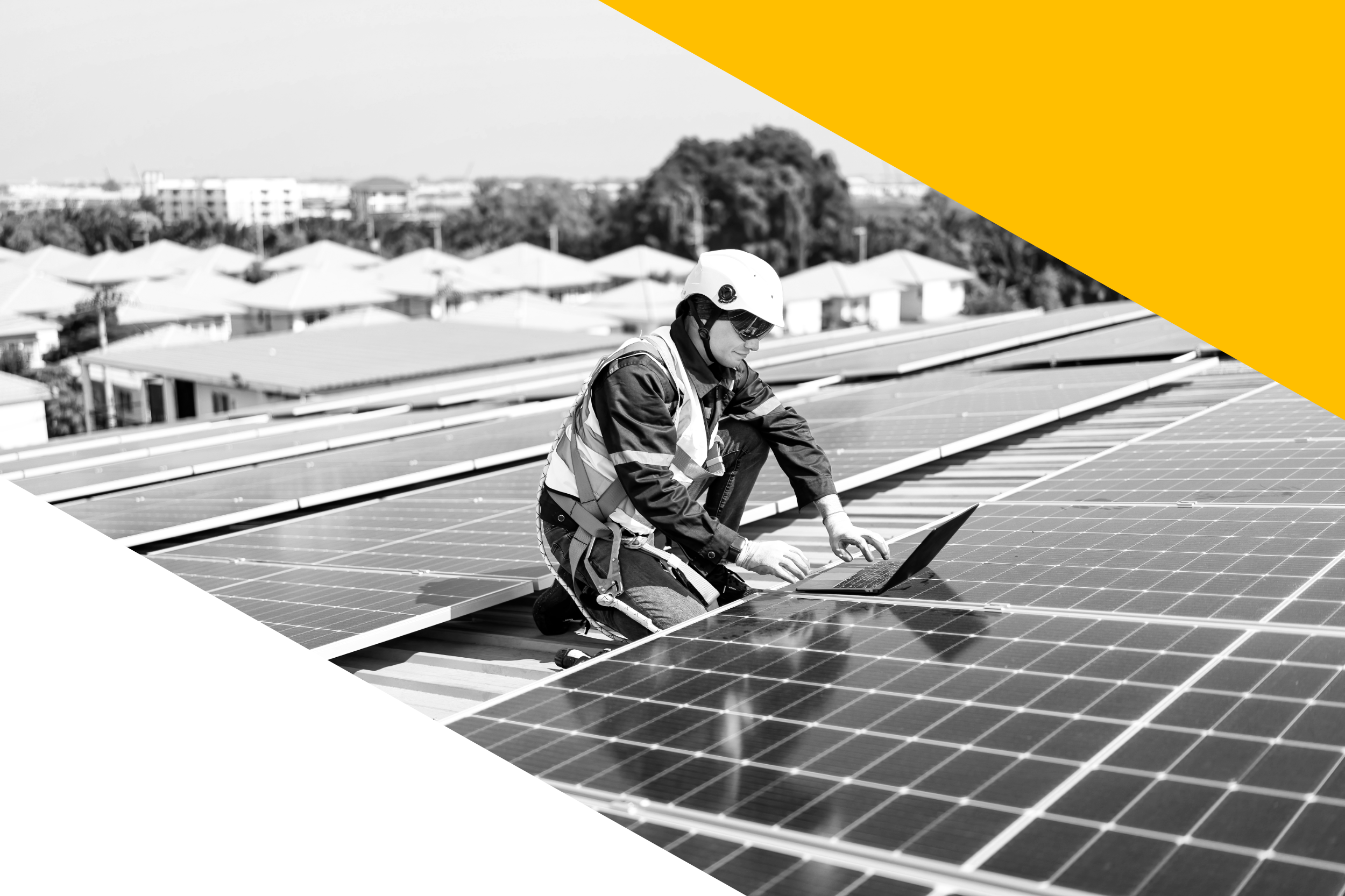
A PV investor makes a long-term investment in a photovoltaic system and receives the revenue generated from the solar power produced. Such photovoltaic investments range from individual rooftop solar systems to large solar parks. At Logic Energy, direct photovoltaic investment takes the form of an inverter revenue share or the purchase of entire solar systems—directly with mediplan Helm e.K., without an intermediary issuer and without a prospectus requirement under the German Investment Act (VermAnlG). This guide explains suitability, the process, returns, taxes, and risks.
Feed-in tariff: a government-guaranteed payment for solar power fed into the grid, fixed for 20 years.
Direct marketing: Sale of solar power on the spot market plus a market premium; legally required for systems of 100 kWp or more.
Inverter Revenue Sharing: A scheme in which investors share in the revenue generated by one or more inverters in a photovoltaic system, without an intermediate fund layer.
kWp (kilowatt-peak): A measure of the installed capacity of a PV system under standard test conditions.
How a solar power system operates efficiently
Photovoltaics convert sunlight directly into electricity—a proven, long-lasting source of energy. In typical locations, a PV system generates approximately 900–1,100 kWh per kWp per year (Fraunhofer ISE 2024). The solar power generated is sold through the EEG feed-in tariff or direct marketing—both ensure predictable revenue for 20 years; PPAs and battery storage further stabilize the yield profile. The Helm Group has been supporting investors for over 40 years—from site acquisition and grid connection to the operation of photovoltaic systems.
Photovoltaics and Renewable Energy in Germany in 2026
EEG Cap for Open-Space Projects, Bidding Date: March 1, 2026 (BNetzA)
Solar Power in 2025 — 16.8% of the electricity mix (Fraunhofer ISE, Jan. 2026)
End of EEG subsidy approval — CfD requirement effective July 17, 2027
In Germany, photovoltaics is the cornerstone of the energy transition—the trend toward and demand for solar energy continue to rise, driven in part by mandatory solar requirements in many federal states. Those who secure a contract before the reform takes effect in 2026 will be granted grandfathering status. Learn more in our overview of the CfD requirement starting in 2027.
Who are photovoltaic investments suitable for?
Anyone looking to invest in photovoltaics will find three target groups here: entrepreneurs with annual profits under €200,000, high-net-worth individual investors interested in a tangible investment, and companies and corporations with excess liquidity. Each group benefits from its own tax advantages and diversification opportunities. The minimum investment is €100,000 in equity.
Three target groups — and when a different approach is better
Unternehmer < 200.000 €
- Doctors, lawyers, engineers, sole proprietors
- IAB and special depreciation under Section 7g of the Income Tax Act can be combined
- Save up to €32,550 on a €100,000 investment
Private investors
- 20–40 years of cash flow backed by physical collateral
- Real assets act as a buffer against inflation (electricity price indexation)
- Direct ownership is an option instead of fund shares
Small and Medium-Sized Businesses & Holding Companies
- Allocate liquidity to secured cash flows
- Straight-line depreciation at 5% over 20 years
- Predictable return over the term
Probably not suitable
- Investment horizon of less than 5 years
- High short-term liquidity needs
- No willingness to hold a referendum on taxes
What is the 6-step process for investing in solar power?
It takes about 6 to 12 months from the initial contact to generating cash flow. As a full-service partner, Logic Energy handles every step of the PV project—from site analysis to commissioning. All you need to do is sign the contract and the easement agreement, and you’ll receive monthly revenue reports starting from the date of commissioning.
From the initial inquiry to the monthly performance report
Initial consultation
Profile & Goal · 1–2 weeks
Project Proposal
Location & Yield · 2–4 weeks
Placement
Co-investors · Weeks–Months
Notary Public & NAZ
Contract & Network Connection · 4–6 weeks
Construction & Commissioning
Logic Glas GmbH · 3–5 months
Operations & Reports
O&M + Performance Reports · 20–40 years
Source: Helm Group, average of PV projects for 2023–2024. Detailed process: How the investor model works.
How much does a solar power system cost, and what kind of return on investment can you realistically expect?
Investment is possible with a minimum equity investment of €100,000. Returns range from 6–12% per annum: 6–10% as a baseline excluding tax effects, and up to 10–12% when fully utilizing the tax benefits under Section 7g of the German Income Tax Act (EStG). The return is primarily determined by the installed PV capacity, the location, and the investment volume. All figures for such a PV investment are net values after costs, before income tax (Helm Group, portfolio data 2024). The payback period is approximately 9–13 years, depending on the system type, location, and self-consumption.
Photovoltaics as an Investment: A Comparison of Returns
Capital costs per kWp — the 2026 benchmark
Market orientation: For large-scale installations, acquisition costs should be below ~€2,000/kWp (without storage) or ~€2,700/kWp (with storage)—depending on capacity, PV modules, and location. One-time costs for notary and land registry fees: 1–2%; lease, O&M, and insurance are already included in the price. Module and acquisition costs have fallen significantly in recent years, improving the economic viability of new projects.
Open space is cheaper, but rooftops are often more cost-effective
Ground-mounted systems are generally less expensive per kWp (standardized mounting structure, no structural analysis required), but they involve longer permitting processes, lease costs, and, in the first feed-in tariff band, a lower EEG rate (5.79 ct/kWh compared to up to 10.00 ct/kWh for rooftop systems over 1 MWp). As a result, rooftop systems often pay for themselves more quickly over their lifetime.
Typical project sizes
From shares in inverters at a 750-kWp commercial rooftop system (below the tender threshold) to solar farms with a ground-mounted capacity of 1–5 MWp. Many investors combine shares in multiple systems to create a geographically diversified portfolio. Technical details: Ground-mounted solar farm.
Why quality comes at a price
At first glance, Logic Energy projects appear more expensive than offers from pure project developers or crowd-investing platforms. The reason: everything from a single source—site acquisition, permitting, grid connection, general contractor construction (Logic Glas GmbH), O&M, and commercial processing. Added to this are N-type modules, a proprietary roof bridging system for industrial roofs, photovoltaic insurance, and a fixed construction price with no risk of cost overruns. This level of integration costs more, but reduces the risk of failure over 20 to 40 years and makes the return calculable over the entire lifecycle.
Which three revenue streams drive your earnings?
Revenues come from three complementary sources: feed-in tariffs under the Renewable Energy Sources Act (EEG) or auction premiums; the direct sale of solar power at a market premium on the spot market; and—when combined with battery storage—arbitrage, PPAs, and system services.
EEG Feed-in Tariff and Tender
The feed-in tariff under the EEG is set by law for systems up to 1,000 kWp; larger systems receive their tariff rate through the BNetzA tender (maximum rate for ground-mounted systems: 5.79 ct/kWh; for rooftop systems over 1 MWp: up to 10.00 ct/kWh).
Direct marketing
For systems of 100 kWp or more, direct marketing is mandatory (Section 21b of the EEG 2023): The solar power is sold on the spot market, supplemented by the market premium and minus the marketing fee.
PPA and battery storage
Long-term power purchase agreements (PPAs) and battery storage generate additional revenue from arbitrage, balancing power, and instantaneous reserve capacity—approximately +1–2 percentage points per year. Since the enactment of the Solar Peak Act, EEG feed-in tariffs no longer apply when electricity prices are negative; as a result, storage at solar parks has become even more important.
An overview of the three revenue streams
| source of revenue | Mechanics | Key figure / Legal basis |
|---|---|---|
| EEG Feed-in Tariff & Tender | Fixed feed-in tariff up to 1,000 kWp; above that, BNetzA tender | 5.79 ct/kWh for ground-mounted systems · up to 10.00 ct/kWh for rooftop systems >1 MWp (EEG 2023) |
| Direct marketing | Monthly market value of solar power (EPEX) + market premium − marketing fee | Mandatory for systems of 100 kWp or more (Section 21b of the EEG 2023) |
| PPA & Battery Storage | Long-term PPA + intraday arbitrage, balancing power, instantaneous reserve | +1–2 percentage points per year · up to €888.50/MWs/year (BK6-23-010) |
| Sources: Federal Network Agency, pv magazine (December 16, 2025), netztransparenz.de. Self-consumption plays only a minor role in the investor model—the systems are optimized for feeding electricity into the grid. | ||
Why Choose Logic Energy for Your Solar Projects?
At Logic Energy, everything comes from a single source: site acquisition, permitting, grid connection, general contractor construction, O&M, and commercial management. As a PV investment expert with over 40 years of experience, the Helm Group combines proven photovoltaic technology with this level of integration—which reduces the risk of failure over 20 to 40 years and makes returns calculable over the entire lifecycle. High-quality N-type modules degrade at a rate of approximately 0.25–0.4% per year, which is below the industry median of about 0.5% (NREL).
Proven photovoltaic technology throughout the entire service life
Everything under one roof
Sales, construction (Logic Glas GmbH), operations, and billing all under one roof.
Personal liability of the owner
The contracting party, mediplan Helm e.K., has unlimited liability pursuant to Sections 1, 17, and 19 of the German Commercial Code (HGB).
N-type modules
Durable technology combined with a proprietary roof bridging system for industrial roofs.
Monthly Income Reports
Actual production, payroll processing, and performance ratio from day one.
Direct investments in solar power, funds, or crowdfunding?
Unlike closed-end PV funds, crowd investing, or a marketplace, direct photovoltaic investments with Logic Energy establish a direct contractual relationship with the personally liable mediplan Helm e.K. — no prospectus under the German Investment Act (VermAnlG), no front-end loads, and no intermediary issuer.
Direct investment in solar power as an alternative to marketplaces
| Feature | Logic Energy (Direct) | Closed-end PV fund | Crowdfunding |
|---|---|---|---|
| Minimum bet | 100.000 € | €10,000–€25,000 | $100–$500 |
| Contracting party | mediplan Helm e.K. Personal Liability of the Owner | Fund Management Company (Limited Partnership/Limited Liability Company) | Platform Issuer (Subordinated) |
| Return (historical) | 6–12% per year | 4–6% of costs | 3–7% interest |
| Soft costs / Surcharge | none | 8–15% of the subscription | Platform fees |
| Access to tangible assets | direct share of revenue | indirectly through fund assets | none |
| Tax (IAB §7g) | usable | often unusable | unavailable |
| Duration | 20–40 years old | Ages 8–15 | 3–10 years |
| Regulation | No VermAnlG prospectus | KAGB / VermAnlG | VermAnlG Information Sheet |
| Source: Helm Group, based on publicly available market data and standard contract terms. Details: Differences between direct investment, funds, and crowd investing. | |||
What tax incentives are available?
Investment Tax Credit (ITC), Special Depreciation, and Straight-Line Depreciation
Three key measures are central: the investment deduction (IAB, §7g(1) EStG), the special depreciation (Sonder-AfA, §7g (5) EStG)—increased from 20% to 40% of the acquisition cost by the Growth Opportunities Act 2024 (for acquisitions on or after January 1, 2024)—and straight-line depreciation over 20 years. For a €100,000 investment and a marginal tax rate of 42%, the tax relief can amount to approximately €32,550 in the first two years (internal sample calculation by the Helm Group). Individual applicability must be verified by a tax advisor.
Calculation example: up to €32,550 in tax savings
Up to 50% of the planned acquisition costs in advance; the maximum total IAB amount per taxpayer as of the balance sheet date is limited to €200,000 (Section 7g(1), sentence 4 of the German Income Tax Act (EStG)). Full breakdown: Save on taxes with photovoltaics in 2026 — IAB, special depreciation, and declining-balance depreciation.
What are the risks associated with solar investments—and how can they be mitigated?
PV investments are business investments that involve four key risks:
Market Risk — Spot Market and PPA Prices After the Expiration of EEG Feed-in Tariffs
Regulatory Risk — CfD Requirement Effective July 17, 2027, for New Contracts
Counterparty risk — Creditworthiness and liability of the contracting party
Liquidity risk — no organized secondary market
Investors who choose to invest in these solar projects benefit from Logic Energy’s personalized owner liability, standardized contracts, grandfathering provisions, and a clear cost structure—all from a single source.
For context: In 2025, there were 573 hours of negative prices on the spot market (SMARD/BNetzA) — once the 20-year EEG feed-in tariff expires, the owner bears the market price; countermeasures include PPAs, storage, and site diversification. In terms of counterparty risk, the personal liability of the sole proprietor is structurally greater than the limited liability of a GmbH (Section 13(2) GmbHG). PV investments are also illiquid—resale is only possible through individual agreements, with no regulated secondary market.
Four risks — and how Logic Energy mitigates them
| Risk | probability | Amount of damages | Countermeasure |
|---|---|---|---|
| Market price Spot market | medium–high | medium | Long-term PPAs, battery storage, portfolio diversification |
| Regulatory matters (CfD effective July 17, 2027) | high | low* | Grandfathering for projects awarded before the deadline |
| Counterparty | low | high | Personal liability of the owner of mediplan Helm e.K. (Section 27 of the German Commercial Code) |
| Power Connection / Technical Specifications | low | medium | Grid connection approval prior to contract signing, O&M |
| Liquidity (Resale) | high | medium | Transparent disclosure; no sales to unsuitable target groups |
| *Low for existing projects. Source: Helm Group, internal risk assessment as of April 22, 2026. Assess risks on a case-by-case basis with a tax advisor and investment expert. | |||
Invest in solar power now — Schedule an initial consultation
During a 30-minute, no-obligation consultation, we will assess your investor profile and prepare a detailed project proposal within two to four weeks.
Please provide current figures on profits and investment goals—this will allow us to reliably quantify the §7g leverage.
Request an initial consultation PV Investment Market Overview 2026About Logic Energy and the Helm Group
Logic Energy is the solar brand of Logic Glas GmbH. As part of the Helm Group, which has been in existence since 1982, it has been guiding investors for over 40 years—from site acquisition and general contractor construction to operation. The contractual partner for the photovoltaic direct investments is the personally liable mediplan Helm e.K. (a registered merchant under Sections 1, 17, and 19 of the German Commercial Code (HGB)).
Conclusion: Getting Started as a Solar Investor in 2026
Becoming a PV investor in 2026 means: predictable cash flows under a 20-year EEG regime, measurable tax benefits under Section 7g of the German Income Tax Act (EStG), and a narrow window of opportunity before the CfD requirement takes effect on July 17, 2027. Through the Helm Group, you can invest in solar energy starting at €100,000—photovoltaic investments as a tangible investment in renewable energy that channels assets into secured cash flows over the long term, with a direct contractual relationship with the personally liable mediplan Helm e.K.
Next steps:
The information on this page is for general informational purposes only and does not constitute investment, tax, or legal advice. Return figures are based on sample calculations from actual projects undertaken by the Helm Group and do not guarantee future results. Any investment decision should be reviewed individually with a tax advisor and an independent investment expert. Tax regulations: Section 7g of the Income Tax Act (EStG) as amended by the Growth Opportunities Act of March 27, 2024 (Federal Law Gazette I No. 108), BMF depreciation table. Proceedings regarding the scope of the IAB are pending before the Federal Fiscal Court (III R 39/25, III B 24/24)—the legal situation may change.
The Logic Energy investor model is a direct ownership of a PV system with a share in inverter revenue or a system purchase—it is not an investment within the meaning of the German Investment Act (VermAnlG), not a financial investment within the meaning of the German Securities Trading Act (WpHG), and does not constitute investment advice under the WpHG. Contractual partner: mediplan Helm e.K., with personal liability of the owner pursuant to Sections 1–6, 17, 19 of the German Commercial Code (HGB). All information regarding returns, terms, and costs is based on portfolio data and contractual standards of the Helm Group and may vary depending on the specific project. As of June 2026.
Request your no-obligation initial consultation!
FAQ
-
You can get started with as little as €100,000 in equity. You acquire a share of the profits from one or more inverters in a photovoltaic system—or, optionally, an entire system. Multiple shares can be combined into a geographically diversified portfolio.
-
6–10% per annum as a baseline, with tax benefits under Section 7g of the German Income Tax Act (EStG) increasing this to up to 10–12% (Helm Group, portfolio data for 2024). Return figures are based on historical data and are not a guarantee of future results.
-
The contractual partner for PV direct investments is mediplan Helm e.K. (a registered business with personal liability of the owner pursuant to Sections 1, 17, and 19 of the German Commercial Code (HGB)). Logic Energy is the brand of Logic Glas GmbH; construction is carried out by Logic Glas GmbH as the general contractor.
-
With the inverter revenue-sharing model, you receive a financial share of the revenue. With the optional system purchase, the photovoltaic system belongs entirely to you. Once the system is commissioned, you become the official owner of your share; the Helm Group remains the operational operator.
-
The initial term is 20 years, guaranteed by the EEG feed-in tariff. An extension option allows the term to be extended to up to 40 years. PV investments are illiquid long-term investments with no regulated secondary market.
-
Businesses with profits under €200,000 may use the IAB method and special depreciation under Section 7g of the German Income Tax Act (EStG), in addition to straight-line depreciation; corporations may use straight-line depreciation at a rate of 5% over 20 years. A tax advisor should verify whether these options apply to your specific situation.
-
For the first 20 years, the EEG feed-in tariff guarantees revenue. After that, the owner bears the market price. Countermeasures include long-term PPAs, battery storage, and geographic diversification across multiple locations.
In-depth information on PV investments
Pillar and Cluster:
Photovoltaic Investment 2026 — Market Overview and Comparison of Investment Options
The Difference Between Direct Investment, Funds, and Crowdinvesting
Mandatory CfDs Starting in 2027 — What the EU Reform Means for New Projects
Regulation and the Market:
Product:
Ground-Mounted Solar Farm — Technical Design for MW-Scale Plants
Solar PV with Battery Storage: Return on Investment, Costs, Co-location
References
§7g EStG (gesetze-im-internet.de) — Investment deduction and special depreciation
HGB §27 (gesetze-im-internet.de) — Personal Liability of the Registered Merchant
BaFin: Investments — Investment Products, Shadow Capital Market, Prospectus Requirements Under the German Investment Act (VermAnlG)
Federal Network Agency — Solar Segment 1 Tender, Bid Deadline: March 1, 2026 — Maximum Price: 5.79 ct/kWh
Fraunhofer ISE — Recent Facts / Levelized cost of electricity: specific yields of 900–1,100 kWh/kWp per year
energy-charts.info (Fraunhofer ISE) — Solar power in 2025: 87.5 TWh, 16.8% of the electricity mix
pv magazine (December 16, 2025) — Record feed-in tariff for rooftop systems over 1 MWp in 2026: 10.00 ct/kWh
SMARD (Federal Network Agency) — 573 hours of negative prices on the spot market in 2025
netztransparenz.de — Instantaneous Reserve, BNetzA Decision BK6-23-010 (Fixed price up to €888.50/MWs/year Premium)
Growth Opportunities Act / Section 7g of the Income Tax Act — as amended on March 27, 2024 (Federal Law Gazette I No. 108), including, among other things, a 40% special depreciation allowance
BFH — Pending Cases — III R 39/25 (Appeal against Hess. FG 10 K 162/24, Scope of IAB)
BFH — Pending Cases — III B 24/24 (Decision on the admissibility of the appeal dated October 15, 2024, IAB pursuant to §3 No. 72 of the Income Tax Act)
Regulation (EU) 2024/1747 (EUR-Lex) — Electricity Market Design Reform, Mandatory CfDs for new price support contracts effective July 17, 2027