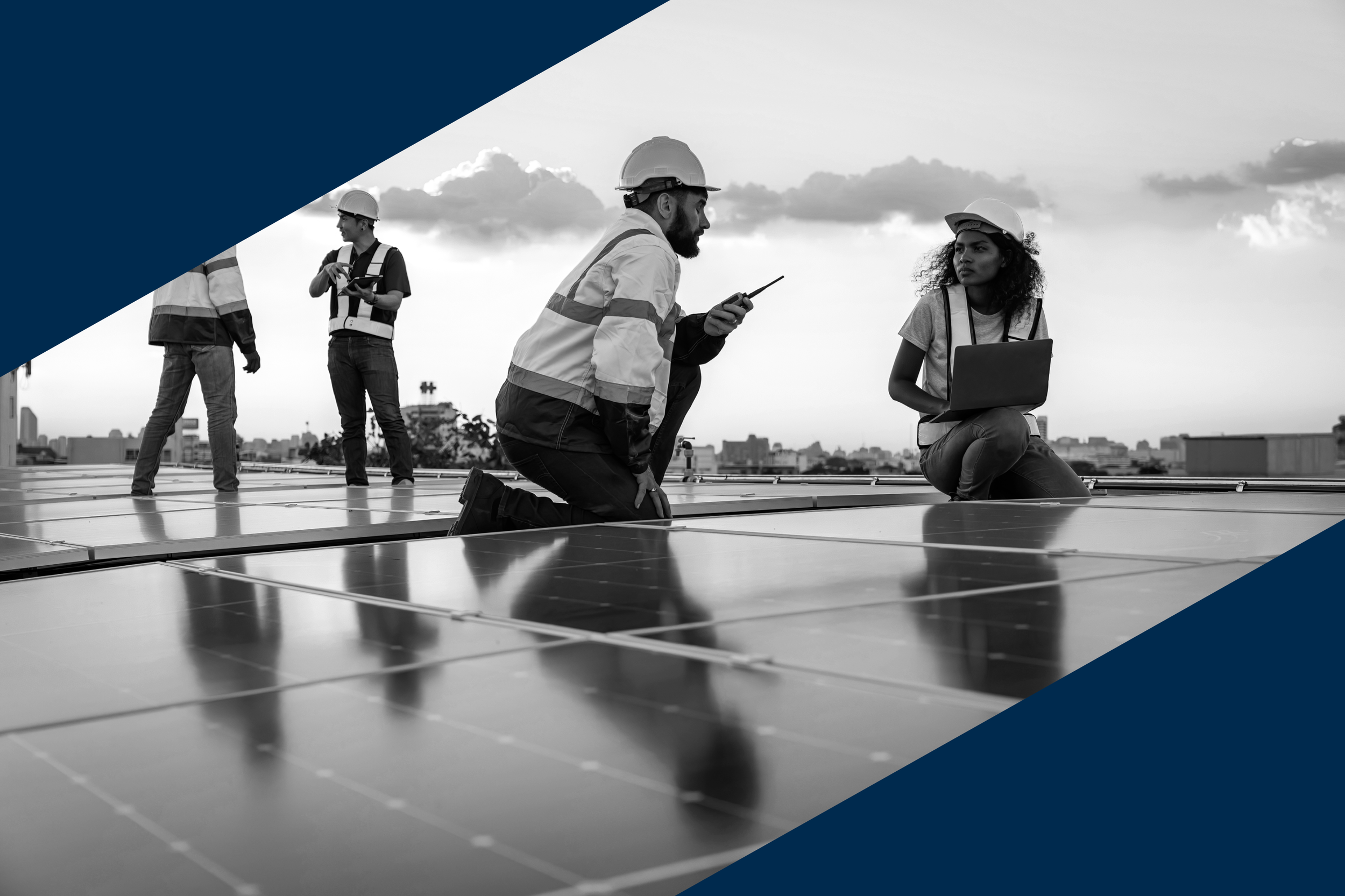
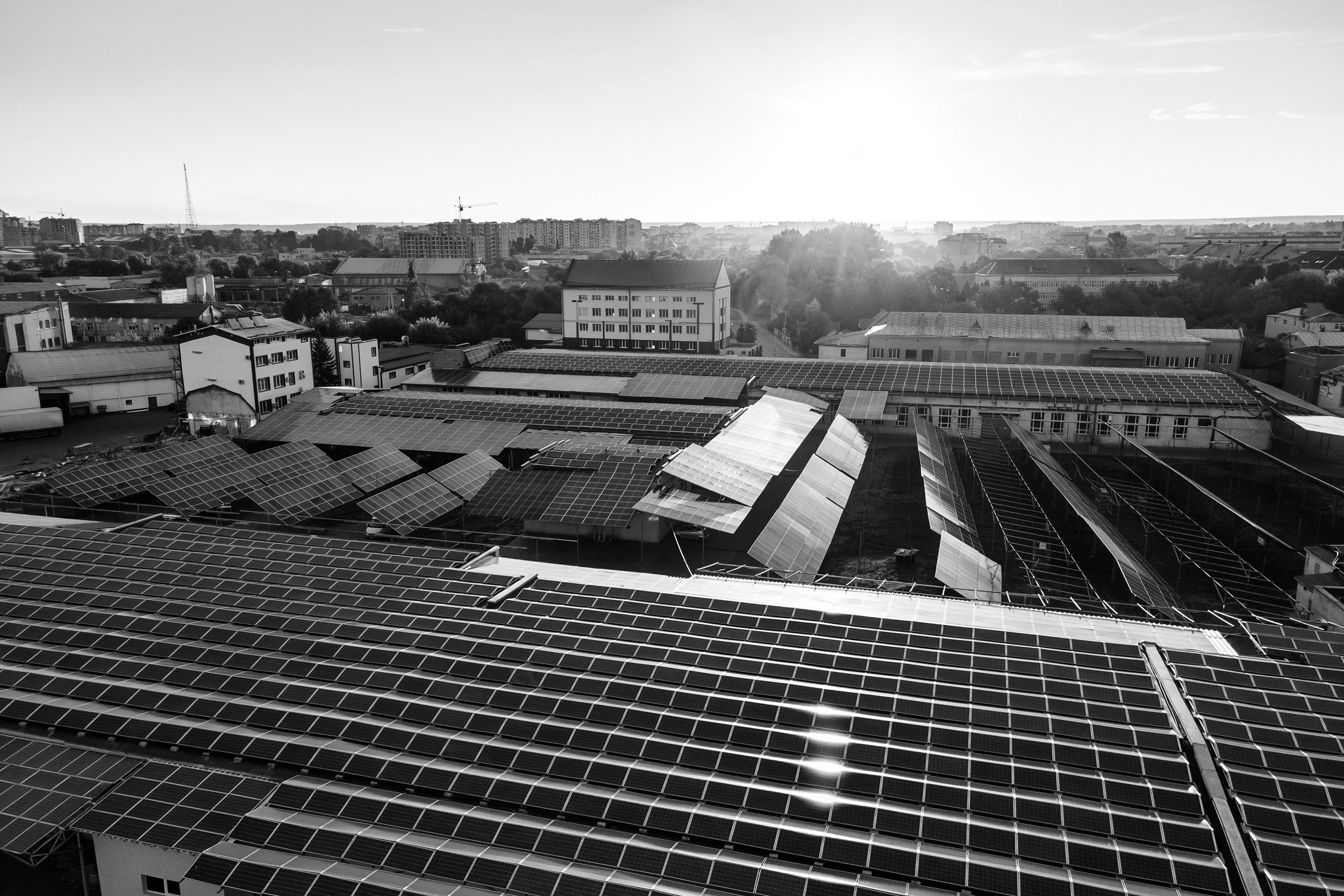
What is a rooftop solar power system?
Turn unused roof space into electricity—even when structural considerations preclude a traditional system. Logic Energy designs, builds, and operates commercial rooftop PV systems—including above-roof, in-roof, and flat-roof systems—and, with its proprietary roof bridging system, can even make use of buildings that other providers would reject.
Why Choose Logic Energy for Your Rooftop Solar System?
Everything under one roof
Feasibility, structural analysis, planning, construction, and operation—a single point of contact from site selection to monitoring.
Proprietary Roof Bridging System
Makes buildings with low load-bearing capacity suitable for solar panels—roofs that others reject become usable.
Personal liability of the owner
The contracting party for investments is mediplan Helm e.K., which is personally liable under Sections 1, 17, and 19 of the German Commercial Code (HGB).
High self-consumption rate
Use up to 90% of solar power directly on-site—for facilities with high daily energy needs, this significantly reduces electricity costs.
The Three Installation Methods: Above-Roof, In-Roof, and Flat Roof
The components are the same for all three types of installations: solar modules with solar cells, a mounting structure, the inverter—which converts the generated direct current into grid-compatible alternating current—as well as meters and cabling. Monocrystalline panels are most commonly used as PV modules; robust glass-glass modules are widely used on commercial roofs with a long service life. A commercial rooftop PV system thus differs clearly from a balcony power plant or small mini-solar systems for residential use—these are permanently installed systems with high photovoltaic output.
Photovoltaics convert sunlight directly into electricity and do not produce any greenhouse gases or pollutants during operation. The service life of a rooftop system is typically over 20 years—panels usually come with performance warranties of 25 to 30 years, and the inverter is typically replaced once during the system’s lifecycle. Ongoing operating costs are low and are essentially limited to insurance, monitoring, and occasional maintenance.
Roof-mounted is the most common installation method: The modules are placed on top of the existing roof covering, which remains the water-bearing layer; on a tile roof, roof hooks secured beneath the tiles hold the modules in place. In-roof systems integrate the modules into the roof surface and replace the roof covering—they offer a high-quality appearance but are more expensive and are generally better suited for new construction or roof renovations. Flat-roof systems are mounted on supports, facing south or in an east-west orientation for a more consistent daily power output curve.
| Construction Method | Typical system size | Annual Yield (Central Germany, South) | Typical application |
|---|---|---|---|
| Roof-mounted (sloped roof) | 5 kWp – 1 MWp | 950–1,050 kWh/kWp | Gable roofs, commercial buildings with a slope |
| Integrated into the roof | 5–50 kWp | 900–1,000 kWh/kWp | New Construction, Roof Renovation, Prestige Projects |
| Flat roof (elevated) | 100 kWp – 5 MWp | 900–1,000 kWh/kWp (south), 830–920 kWh/kWp (east-west) | Industrial and Logistics Buildings |
| Source: BSW-Solar, Market Statistics 2025; Fraunhofer ISE LCOE Study, July 2024. Figures are approximate and vary depending on location and design. | |||
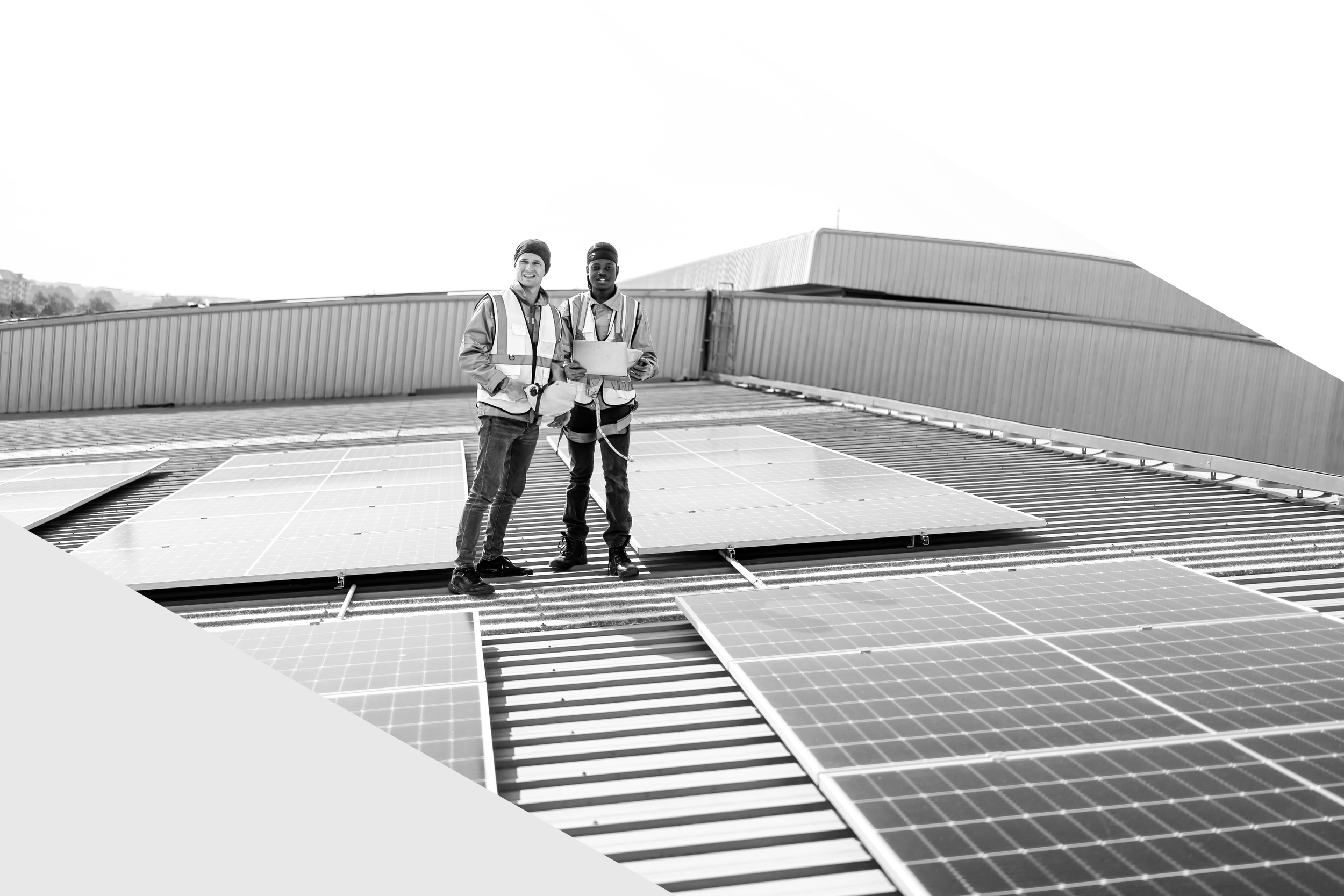
Is your roof suitable for a solar power system?
Structural Engineering: The key question is point load versus distributed load. Older industrial buildings often have structural reserves covering only 30–60% of the roof area because trapezoidal profiles between the trusses have limited load-bearing capacity. Only a structural analysis report can provide a definitive answer—rules of thumb are no substitute. If the structural reserve is insufficient, a roof bridging system is an alternative that transfers the load to the main trusses rather than to the roof sheathing.
Orientation and Tilt: The compass direction determines the specific yield. South at 30° is considered the reference (100%); east-west orientation yields slightly less, but the output is more consistent throughout the day. Roof Condition: The roof’s remaining service life should cover the system’s operational lifespan—renovating the roof after installation is expensive.
System Size: The appropriate system capacity depends on the roof area and the business’s electricity demand. As a rule of thumb, a rooftop PV system requires about five to seven square meters of module area per kWp; modern monocrystalline modules will achieve an efficiency of about 20 to 23 percent by 2026 (Fraunhofer ISE, as of May 2026). A 10 kWp system therefore occupies roughly 45 to 55 m². For commercial roofs, the photovoltaic capacity scales according to the available area.
| Orientation | Inclination | Relative Return | Specific annual yield |
|---|---|---|---|
| South | 30° | 100 % | ≈ 1,000 kWh/kWp |
| South | 10° (flat roof) | 95 % | ≈ 950 kWh/kWp |
| East-West | 10° (flat roof) | 92 % | ≈ 920 kWh/kWp |
| East or West | 30° | 85–90% | 850–900 kWh/kWp |
| North | 30° | 70 % | ≈ 700 kWh/kWp |
| Source: Fraunhofer ISE, July 2024. Values for Central Germany; regional solar irradiance and shading affect the results. | |||
The Roof Bridging System: Useful Where Others Say No
For many older industrial buildings, a rooftop system is ruled out for structural reasons before its economic viability has even been assessed. The traditional solution—renovating the roof before installing the PV system—often costs more than the system itself and does not pay for itself through electricity revenue. The roof bridging system resolves this conflict structurally: Instead of transferring the loads into the roof deck, a support structure spans the entire roof and transfers the weight of the modules as well as snow and wind loads directly to the main trusses and exterior walls.
Structurally, it consists of a box-girder or truss system made of galvanized steel that runs parallel to the ridge across the roof. The modules are mounted on this secondary support structure, not on the existing roof. An air gap remains between the beams and the existing roof surface, which additionally improves rear ventilation of the modules—a side effect that increases the specific yield by a few percent.
The design advantage: The load-bearing capacity of the existing roof need only be sized to accommodate the dead load of the bridging system plus wind uplift, not the full PV load. This makes it possible to use buildings that were previously structurally unsuitable for a conventional load—roofs that other providers reject can thus be utilized.
Module, snow, and wind loads are transferred to the roof sheathing and the trapezoidal profiles.
If the load-bearing capacity is low, roof renovation is necessary—which is often more expensive than the system itself.
Result: Many older buildings are considered “unsuitable for solar panels.”
A secondary structural system made of galvanized steel transfers the loads to the main trusses and exterior walls.
The existing roof must only support its own weight plus wind loads— not the full weight of the PV system.
Result: Even statically sealed roofs can be put to use; the air gap improves rear ventilation.
Which buildings benefit the most?
Production and industrial facilities operating on a single or multi-shift basis can cover nearly all of their solar power needs themselves—the base load is generated during daylight hours. Logistics and warehouse facilities offer very large, often unused flat roofs; self-consumption depends on the operation of the cooling, conveyor, and loading infrastructure. Office buildings and retail facilities have significant daytime demand but smaller roofs. Agricultural buildings—barns, machinery sheds, and storage facilities—combine large roof areas with energy consumption that can be well managed through storage or revenue sharing.
| Building Type | Roof area | Self-consumption rate (per day) | Distinctive feature |
|---|---|---|---|
| Production/Industrial Building | large | 70–90% | Continuous base load during daytime operations |
| Logistics/Warehouse | very large | 40–80% | Depending on the cooling and charging infrastructure |
| Office Buildings / Retail | medium | 30–60% | High daily requirements, smaller area |
| Agricultural Building | large | 30–70% | Good for storage or profit sharing |
| Source: SMA Solar, Commercial Self-Consumption Reference Guide, 2024. Values depend on the load profile and are provided for guidance only. | |||
Solar Mandate: What Applies in Your State
The specific occupancy rate and the triggering event—new construction, renovation, or roof renovation—vary from state to state. The following overview lists the rate and legal basis for each state as of Q1 2026. The current statutory text of the respective state always takes precedence.
Tax incentives such as the investment deduction under Section 7g of the Income Tax Act (EStG), as amended by the Growth Opportunities Act of 2024, apply nationwide. In addition, since 2023, a 0% value-added tax rate has applied to the purchase and installation of a PV system (Section 12(3) of the Value-Added Tax Act (UStG)), and systems up to 30 kWp per unit are exempt from income tax (Section 3 No. 72 of the Income Tax Act (EStG))—for smaller roofs, this reduces electricity costs and saves money without any bureaucratic hassle. The article on “Photovoltaics, Taxes, and Savings” discusses in detail how these incentives and other factors affect cost-effectiveness.
| State | Occupancy rate | Legal basis |
|---|---|---|
| Baden-Württemberg | 60% of the suitable area | Climate Act of Baden-Württemberg, Section 8a |
| Berlin | 30% of the gross roof area | Berlin Solar Energy Act, Section 3 |
| Hamburg | 30% of the suitable area | HmbKliSchG § 16 |
| Hesse | in accordance with state regulations | HEG § 9 |
| Lower Saxony | 50% of the suitable area | Section 32a of the Climate Act |
| North Rhine-Westphalia | in accordance with state guidelines (expanded starting in 2026) | NRW Building Code § 42a |
| Rhineland-Palatinate | 60% of the suitable area | LSolarG RP § 3 |
| Schleswig-Holstein | in accordance with state regulations | EWKG § 9 |
| Bremen | 50% of the suitable area | BremSolarG § 2 |
| Source: respective state laws, as of Q1 2026. As of Q1 2026, Brandenburg, Mecklenburg-Western Pomerania, Saxony, Saxony-Anhalt, Thuringia, and Saarland do not have a general solar installation requirement for existing commercial buildings; regulations for new construction exist in some cases. Information provided without warranty—the current text of the law is authoritative. | ||
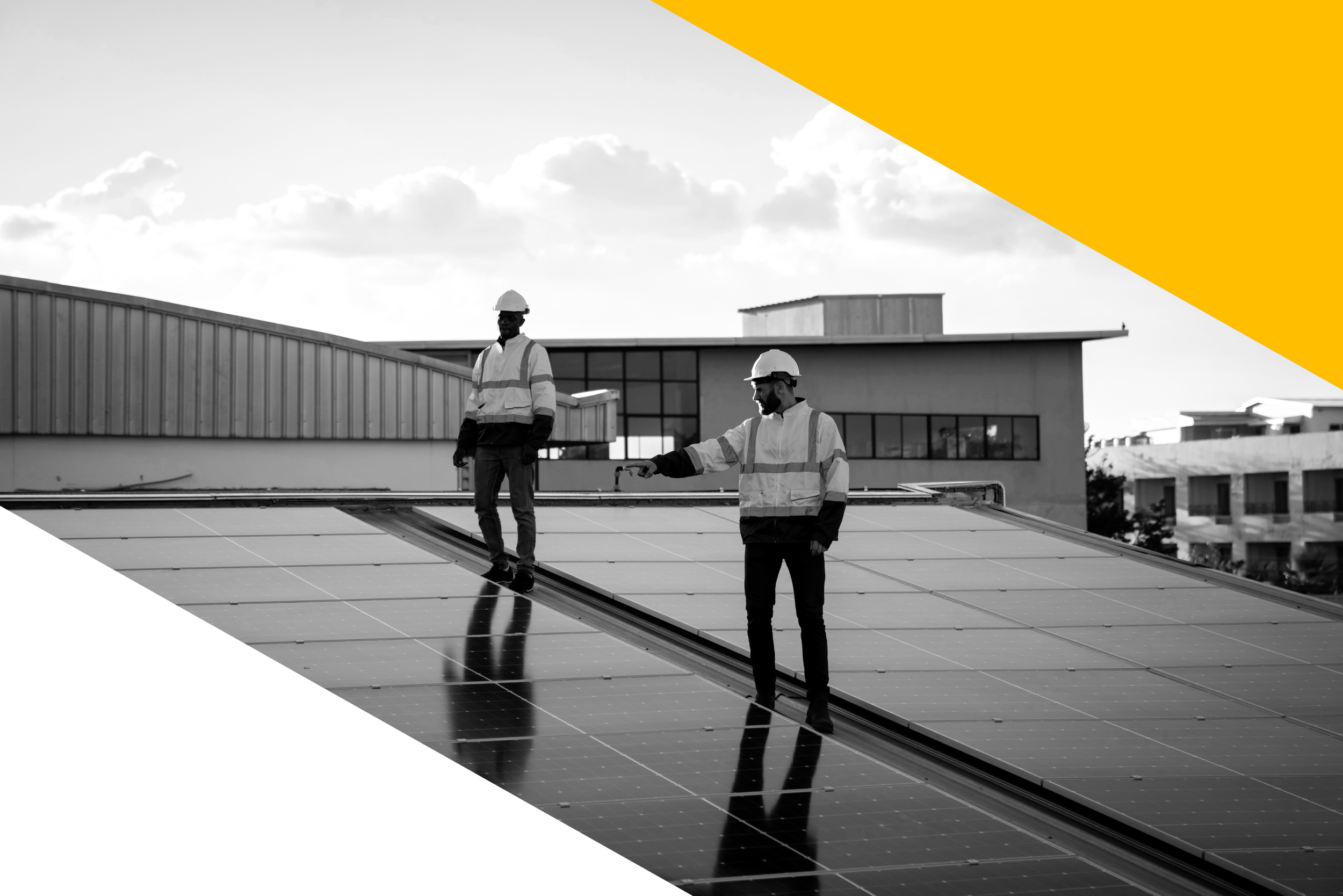
5 Steps to a Complete Roof System
Roof Analysis
Check roof structure, load-bearing capacity, and grid connection · 2–4 weeks
Detailed Planning
Design, construction method, and, if applicable, bypass system
Approval
Grid Connection Commitment and Approvals
Construction
Installation and Commissioning
Monitoring
Day-to-Day Operations and Profit Monitoring
Done
Total completion time: 4–9 months, depending on size
The first step is a feasibility study: the roof structure, load-bearing capacity, and grid connection capacity are assessed before a cost estimate can be provided. If the structural analysis indicates insufficient load-bearing capacity, Logic Energy evaluates a roof bridging system as an alternative to roof renovation. This is followed by detailed planning, obtaining approval with a grid connection commitment, construction and commissioning, as well as ongoing monitoring of the system.
The following applies to connection to the power grid: Every photovoltaic system must be reported to the local grid operator and registered within one month in the Federal Network Agency’s market master data registry—without this registration, there is no entitlement to EEG remuneration. The solar power generated can be used on-site or fed into the public grid. For electricity fed into the grid, grid operators and energy suppliers pay a statutory feed-in tariff; for new systems up to 10 kWp, this has been 7.70 cents per kWh (partial feed-in) since August 2026 and is valid for 20 years from the date of commissioning (Federal Network Agency, as of Feb 2026). Logic Energy handles the registration and grid connection for the project.
The guide *Photovoltaics for Industry & Commerce* provides a detailed breakdown of costs, including funding options and a profitability analysis.
| Equipment segment | Turnkey €/kWp | Source |
|---|---|---|
| 5–10 kWp | €900–€1,500 per kWp | Fraunhofer ISE / BSW-Solar, Q1 2026 |
| 30–100 kWp | €800–€1,300 per kWp | Fraunhofer ISE / BSW-Solar, Q1 2026 |
| 100–500 kWp | €700–1,100 per kWp | Fraunhofer ISE / BSW-Solar, Q1 2026 |
| 500 kWp and up | €600–1,000 per kWp | Fraunhofer ISE / BSW-Solar, Q1 2026 |
| Source: Fraunhofer ISE / BSW-Solar Price Monitor Q1 2026. The benchmark average for turnkey systems is approximately 1,015 €/kWp (Fraunhofer ISE, July 2024). These figures are for reference only; actual calculations depend on the roof structure, structural analysis, and grid connection. | ||
Is your roof a good fit? Let's find out.
We'll assess the load-bearing capacity, orientation, and utility connection, and let you know whether a traditional rooftop solution or the roof bridging system is right for your building—with no obligation.
Battery Storage: When It's Worth It
The economic sizing depends on the load profile. For single-shift production, direct self-consumption is already 70–90% even without storage—a solar power storage system offers little additional benefit in this case. It becomes worthwhile when load peaks occur outside of daylight hours, when charging stations for electric vehicles are used in the evening, or when the goal is to increase self-sufficiency. A storage system is sized based on usable capacity—starting at around 10 kWh for smaller commercial installations, and correspondingly higher for larger solar systems. The technical basics are explained in the “PV Battery Storage” technology pillar.
A Rooftop Solar System as an Investment—Without Owning Your Own Property
For businesses:
YOUR ROOF. YOUR ENERGY FUTURE. YOUR RETURN ON INVESTMENT.
Do you have a commercial, industrial, or logistics building with unused roof space? Turn it into a profitable source of energy. With commercial solar systems, you can reduce electricity costs by up to 80%, increase your energy independence, and enhance your company’s image—all without any maintenance on your part.
What you get:
Drastic cost reduction
70–90% self-consumption even without storage (during daytime operation)
With storage, self-sufficiency of over 80% is possible
Protection against rising energy costs
Making solar installation requirements profitable rather than merely compliant with the law
Increase property value
Improved ESG Reporting
Full-service support:
We handle planning, construction, maintenance, insurance, and operations (O&M)—you don’t have to lift a finger
Even for "challenging" roofs:
Many industrial roofs are considered "unsuitable for PV" because they can only support the weight in certain areas. With our proprietary roof bridging system, we make even these roofs usable—we can develop areas that other providers turn down.
You have two options:
Option 1: You invest on your own
You finance the system and receive all the savings + feed-in tariffs. Highest return on investment. Many companies take advantage of tax planning options such as IAB (Section 7g of the German Income Tax Act) or special depreciation allowances. Talk to your tax advisor about your specific situation.Option 2: Zero-Investment Model
We invest in, build, and operate the facility. You use the electricity on favorable terms—without making any investment of your own. Ideal for businesses looking to save capital.
Let’s work together to see if a solar power system is a good investment for your business—free of charge and with no obligation.
Is the IAB worth it for photovoltaic systems?
The IAB is worthwhile for active businesses, freelancers, and investors with taxable profits below the 200,000-euro threshold, a high marginal tax rate, and a commercial solar system exceeding 30 kWp, at least 90% of whose electricity is used for business purposes. It is not worthwhile for tax-exempt systems up to 30 kWp (Section 3, No. 72 of the Income Tax Act) or for systems without an active business.
Whether the investment deduction is worthwhile is not a matter of the size of the investment alone, but of the tax environment. Four factors are decisive: Is there a taxable profit from which the deduction can be taken? Is this profit less than 200,000 euros in the year of the deduction? What is the individual marginal tax rate—since the tax relief is proportional to it? And is the investment realistically scheduled to take place within the three-year period? Anyone who can answer “yes” to all four questions has, with the IAB, one of the most powerful tax tools available under German law at their disposal.
Who Benefits from the IAB — and Who Doesn't
- Active business with profit-based income —sole proprietors, partnerships, corporations, self-employed professionals, farmers, and foresters
- Investor with a direct investment in a commercial PV system, properly classified as a separate movable asset
- Profit in the tax year of less than €200,000
- System with a capacity of over 30 kWp; ≥ 90% of the electricity is used for operational purposes
- High personal marginal tax rate (proportional effect)
- Investment Realistically Planned Within 3 Years
- Residential solar power systems up to 30 kWp – Section 3, No. 72 of the Income Tax Act (EStG) applies; no deductible profit arises
- More than 10% of the property is used for personal residential purposes
- No category of income —pure asset management or capital investor without a business
- Profit of over €200,000 in the tax year
- IAB: purely speculative , "for future use," with no intention to invest
The dividing line is not between large and small, but between taxable and tax-exempt. A farmer with a 300-kWp greenhouse roof system, a logistics company with an open-field solar park, and a freelancer with a commercial direct investment are on one side. On the other side are residential PV systems up to 30 kWp, systems where the electricity is primarily consumed by the owner, and pure equity investments without a commercial component.
Calculation Example: IAB for a 100,000-Euro Investment
| Position | Amount / Value |
|---|---|
| Planned Investment (Estimated Acquisition Costs) | 100.000 € |
| IAB Advance Deduction (50%, Section 7g(1) of the Income Tax Act) – in the year of deduction, prior to the purchase | − 50.000 € |
| Assumed marginal tax rate | 42 % |
| Tax Deferral in the Year of Deduction (Pure IAB) | ≈ 21.000 € |
| Conceptual example, pure IAB effect. When combined with special depreciation (§ 7g(5)) and declining-balance depreciation, the cumulative tax relief over two fiscal years rises to as much as 77.5%—27.5% in the investment year alone. That amounts to €77,500 in expenses → approximately €32,550 in tax savings—but only if the 42% applies to the entire deduction; this assumes a taxable income of approximately €120,000 before the deduction. Below that threshold, a portion falls into the progressive tax bracket, and the effect is then reduced. The detailed mechanics are explained in the main tax article. The marginal tax rate is an assumption; your individual rate may vary. This is not tax advice. Source: Section 7g of the German Income Tax Act (EStG). For those using the IAB for the first time: Investment Deduction —Requirements, Profit Threshold, and Three-Year Period. | |
This example illustrates the pure IAB effect: A planned investment of 100,000 euros results in an upfront deduction of 50,000 euros, which reduces taxable income in the year of the deduction—before the purchase is made. Assuming a marginal tax rate of 42 percent, this corresponds to a tax deferral of approximately 21,000 euros. Combined with the special depreciation under Section 7g(5) of the German Income Tax Act (EStG) and declining-balance depreciation, the cumulative tax relief over two fiscal years rises to up to 77.5 percent of the investment amount—that is, 77,500 euros in expenses and thus approximately 32,550 euros in tax benefits, provided that the 42 percent rate applies to the entire deduction — this assumes a taxable income of approximately 120,000 euros before the deduction. In the year of investment itself, the relief is 27.5 percent, because the 50 percent IAB is already incurred in the year prior to the acquisition. This figure assumes a purchase in January; if the asset is put into service in October, the rate drops to approximately 71.9 percent. You can find the detailed calculation of how these factors interact in our main tax article. The marginal tax rate is an assumption; your individual rate and the specific impact depend on your overall financial situation.
When the IAB Does Not Apply: The Exclusion Under § 3 No. 72 of the Income Tax Act (EStG)
For systems up to 30 kWp per residential or commercial unit, the tax exemption under Section 3, No. 72 of the Income Tax Act (EStG) applies. These systems do not generate taxable income—and thus no profit from which an IAB could be deducted. For the typical residential or small-scale system, the IAB is therefore not a useful tool, regardless of the individual’s tax rate. It only takes effect above the 30-kWp threshold, on a commercial scale. Details on this special situation are provided above in the section on the special legal situation.
Risks: What Could Bring Down the IAB
| Risk | What happens | Weight |
|---|---|---|
| No purchases within 3 years | Retroactive reversal in the year of deduction, back taxes + interest at 1.8% per annum (Section 233a in conjunction with Section 238 of the German Fiscal Code (AO)) | High |
| Profit threshold of €200,000 exceeded | IAB is not permitted in the year of deduction—the advance deduction is eliminated entirely | Medium |
| 90% utilization broken / no clear operational basis | Recognition does not apply; the IAB is reversed (e.g., in the case of high private consumption) | Medium |
| Unresolved BFH Case Law Regarding Tax-Exempt Investments Under the Old IAB | Legal Uncertainty Regarding Existing Cases of ≤30 kWp (Case III R 39/25, pending as of July 2026) | Observe |
| Traffic light rating provided by the Logic Energy editorial team for guidance only; not tax advice. Legal basis: Section 7g(1)–(4) of the Income Tax Act (EStG), Sections 233a and 238 of the Fiscal Code (AO), Federal Fiscal Court (BFH) Case III R 39/25. Overview of requirements, deadlines, and reversal of transactions: Investment deduction. | ||
The IAB is an advance payment from the tax office for an investment that has not yet been made—and that is precisely where its risks lie. If the planned investment is not made within three years, the tax office retroactively revokes the deduction in the original year and charges interest on the additional tax liability at the current rate of 1.8 percent per year. If business use falls below the 90 percent threshold or if profits exceed the 200,000-euro limit, the deduction is forfeited. That is why the rule of thumb is: only claim the IAB once the investment has been definitively decided—not speculatively in advance.
Should you check the IAB for your PV investment?
Logic Energy designs and builds systems precisely within the size range covered by the IAB in a legally compliant manner—commercial rooftop systems, ground-mounted solar parks, and agri-PV. Your tax advisor will handle the tax assessment on a case-by-case basis.